


7 Tips to Reduce Prototype Costs
May 13
3 min read
We see it constantly: an engineer submits a solid drawing, gets a quote three times the budget, and assumes the vendor is overcharging. More often, the design itself is the issue — unnecessary complexity, over-specified tolerances, or materials chosen for the final product rather than the prototype stage. These seven tips address the most common culprits.

01 Simplify the geometry — especially chamfers and undercuts
Every non-standard chamfer angle, deep undercut, or internal cavity adds a machining setup. More setups mean more cost. Ask yourself: Does this feature need to exist in the prototype? If an undercut is decorative, remove it. If a chamfer is non-standard, standardize it to 45°. These are prototype-appropriate decisions, not engineering compromises.
Tip: Match internal corner radii to standard end mill sizes (R3, R5, R6). A custom radius like R4.3 requires a tool change — and tool changes add cost.
02 Match the material to what the prototype actually needs to prove
Unless you're validating corrosion behavior or specific mechanical properties, aluminum 6061 will answer the question at a fraction of the price. Stainless steel runs 4–6× more expensive to machine; titanium, 8–12×. For pure form-and-fit checks, engineering plastics or SLA prints eliminate machining costs entirely. Use expensive materials when the prototype genuinely needs them — not by default.

03 Choose the process for the prototype stage, not the production part
CNC machining isn't always the right call. A rough guide:
· Testing geometry or fit? → 3d printing, fast and cheap
· Need functional loads? → CNC aluminum; 2.5-axis where possible
· Need 5–20 plastic units? → Vacuum casting beats running 20 CNC parts
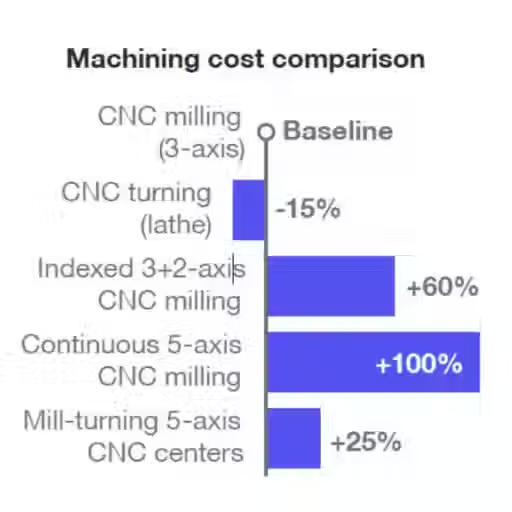
If your part can be done in 2.5-axis instead of 5-axis, that alone is a meaningful cost reduction.
04 Stop over-tolerancing — most features don't need it
Tight tolerances (±0.01mm) on non-contact surfaces force slower feeds, more measurements, and potential reworks — for no functional gain. Apply tight tolerances only where the design actually requires them: bearing seats, mating faces, press-fit holes. Use ±0.1mm or looser everywhere else. On complex parts, this single change can cut machining time by 20–40%.
05 Request a design review before you submit
Most shops will flag manufacturability issues for free if you ask — and catching them before machining starts costs nothing. Common findings: walls too thin for stable machining, blind tapped holes in tight sections, and non-standard thread sizes requiring special tooling. None of these is hard to fix in CAD. All of them are expensive to fix in a finished part.
06 Reduce part count wherever possible and Surface Finishing Requirements
Every additional part means another quote, another setup, another inspection step, and assembly labor on top. Before finalizing your BOM, ask whether two or three parts could be consolidated into one. A slightly more complex single part is almost always cheaper than three simpler ones bolted together.
Surface finishes like polishing, anodizing, or painting add both labor and time costs.
Tips:
· Use “as-machined” finish where possible
· Limit cosmetic finishes to visible areas only
· Avoid unnecessary multi-step finishing processes
Surface finishing can account for 10–25% of total prototype cost.

07 Order slightly more than you think you need
Per-part cost drops between 1 and 5 units sharply — setup cost is fixed, so more parts means lower cost each. Ordering 3–5 units instead of 1–2 typically cuts unit cost by 35–55%. If the design is stable and you expect to do any destructive testing, the extra units almost always pay for themselves. Submitting multiple part files together in one order can also unlock combined-order discounts.


FAQ (Featured Snippet Ready)
How can I reduce prototype cost quickly?
Simplify your design, choose cost-effective materials, and use the right manufacturing process, like 3D printing for early-stage prototypes.
What is the cheapest prototyping method?
3D printing is usually the most affordable for low quantities, while injection molding becomes cheapest at high volumes.
Does CNC machining cost more than 3D printing?
Yes, cheap CNC machining is typically more expensive than 3D printing for small batches, but it offers better precision and material strength.
Looking to reduce your prototype cost without sacrificing quality? Contact us today for a free and fast, competitive quote for your next project.
Comments